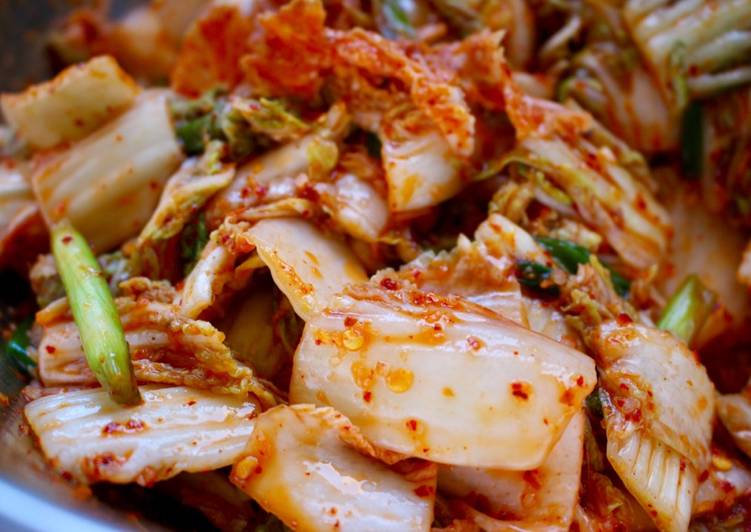
Hello everybody, it’s Drew, welcome to our recipe page. Today, I’m gonna show you how to make a distinctive dish, kimchi (easier than you think! ;) ). It is one of my favorites food recipes. This time, I will make it a little bit unique. This will be really delicious.
Kimchi (Easier than you think! ;) ) is one of the most favored of current trending meals in the world. It’s easy, it is fast, it tastes delicious. It’s enjoyed by millions daily. Kimchi (Easier than you think! ;) ) is something that I have loved my entire life. They are fine and they look fantastic.
Kimchi is a traditional Korean dish of fermented vegetables and spices, in particular ginger, garlic, peppers and hot chilies. Kimchi: AKA fermented cabbage, is one of the healthiest foods for your gut. Chef Randy Feltis shares how to make the dish yourself.
To get started with this recipe, we must first prepare a few components. You can have kimchi (easier than you think! ;) ) using 11 ingredients and 9 steps. Here is how you cook it.
The ingredients needed to make Kimchi (Easier than you think! ;) ):
- Make ready 4-5 pounds Napa cabbage, cut into roughly 1"x 2" pieces (about 30 cups of chopped raw cabbage)
- Make ready 1 bunch green onions, washed, roots trimmed, and cut into 2 inch segments
- Get 5 Tablespoons kosher salt (about 10% less if you're using regular table salt)
- Make ready For the paste:
- Prepare 1/4 cup minced garlic (about 5 or 6 large cloves)
- Get 1/4 cup minced fresh ginger root (about a 2" segment, peeled)
- Get 1/4-1/2 cup crushed red chili flakes depending on how hot you want your kimchi. See notes above re: gochugaru
- Make ready 1/4 cup steamed white rice, lightly packed. Short or long grain is fine. If stale, microwave with 2 Tbsp. water for 1 minute
- Get 1/4 cup fish sauce
- Prepare 1/4 cup sugar
- Get 1/4 cup water for blending + 1/3 cup water for rinsing seasoning from bowl (see directions below)
So, making kimchi was just one of those things I avoided. Epidemiological evidence that kimchi consumption may significantly increase cancer risk. I think you should search and find out more information. I couldn't find any sources to support the video Not enough said for me.
Instructions to make Kimchi (Easier than you think! ;) ):
- In a large stainless steel or mixing bowl, toss the raw cabbage, green onion, and the salt together to pre-brine the cabbage. Make sure to thoroughly incorporate the salt throughout the cabbage. In 10 to 15 minutes, you should start to see the cabbage leach liquid and wilt. Let the cabbage sit for 1.5 to 2 hours, tossing and redistributing every 30 minutes to ensure even brining.
- After at least 90 minutes of pre-brining, rinse the cabbage with enough water to cover the cabbage by 4 or 5 inches by swishing the cabbage in the water 7 or 8 times. Remove the cabbage into a strainer and let the excess water drain while you prepare the paste.
- Make the paste by putting all the paste ingredients into a blender and blend until you can't see the individual grains of rice. Pour the paste over the cabbage.
- Get into the bowl with your hands and mix the paste into the cabbage until all the pieces are evenly and thoroughly coated.
- Pack your kimchi into a clean, dry bottle or other tight-lidded container (this time I repurposed a half gallon kimchi jar) and use the last 1/3 cup of water to swish around the mixing bowl, pick up all the remaining paste, and pour that liquid on top of your kimchi. Remember to leave 2 to 3 inches of headspace at the top to allow for expansion as fermentation takes place.
- Your batch of kimchi is now ready for fermentation in a dark but not cold place like the inside of your cupboard. Or, if you can find a warmish spot in your garage, you can put it there. (I know that's not always possible for cold climate people in the middle of winter.) As it ripens, it's a good idea keep the lid slightly unscrewed to relieve the pressurization caused by fermentation. (Your jar can literally explode from the pressure on a specially active fermentation day.)
- People often ask HOW RIPE DOES THE KIMCHI HAVE TO BE BEFORE I REFRIGERATE OR EAT IT? You can eat the kimchi whenever you want. Fresh, just after it's been made, all the way up to when it's so incredibly old, ripe and stinky you could choke out a subway system by placing an open jar in one of the vents. It remains safe for human consumption for A VERY LONG TIME.
- But as to when to refrigerate, just go out once a day every day to taste a piece, and when it gets to the ripeness you like, stick it in the fridge. It'll continue to ripen, but very slowly.
- Enjoy! :)
The article you linked to is simply a reminder of how easy it is to attack another. I made kimchi last week, and it has been sitting in on my kitchen floor for three days. The problem is, it will NOT (If someone has knowledge about kimchi-chem…) but I think it would be easier to start over… you put sugar in the kimchi-paste? enough gochugaru. It is easier than you think! When you use easierthanyouthink.ca, you can connect to your course and specific lesson and review and practice at your own pace.
So that’s going to wrap this up for this special food kimchi (easier than you think! ;) ) recipe. Thanks so much for your time. I am confident that you will make this at home. There’s gonna be more interesting food in home recipes coming up. Don’t forget to save this page in your browser, and share it to your family, colleague and friends. Thank you for reading. Go on get cooking!